
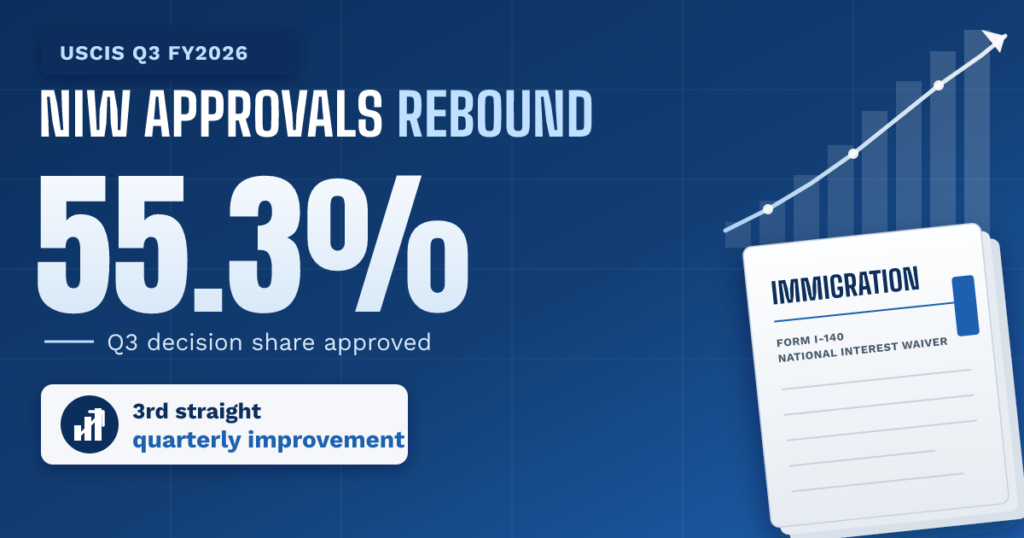
The latest USCIS data brings a notable change for EB-2 National Interest Waiver petitioners.
USCIS approved 3,835 EB-2 NIW petitions and denied 3,103 during the third quarter of fiscal year 2026, according to newly released Form I-140 data covering April through June 2026.
That means approximately 55.3 percent of NIW petitions decided during the quarter were approved, based on approvals divided by approvals plus denials.
It is the third consecutive quarterly improvement in the NIW decision share. In FY2026 Q1, roughly 42.5 percent of decided NIW petitions were approved. The figure increased to about 48.1 percent in Q2 and then crossed 55 percent in Q3.
The latest numbers do not mean NIW has suddenly become easy. They do show a meaningful reversal from the deterioration seen in prior quarters.
More than 13,800 new NIW petitions arrived in three months
Demand also remains exceptionally high. USCIS received 13,831 new NIW petitions in Q3 alone. That follows approximately 13,884 receipts in Q1 and 12,648 in Q2. Combined, USCIS received more than 40,000 NIW petitions during the first nine months of FY2026.
Unlike most employment-based second-preference cases, an NIW applicant may request that USCIS waive the normal job-offer and labor-certification requirements if the applicant can satisfy the governing national-interest standard. USCIS guidance also states that a person seeking an NIW must first qualify for the underlying EB-2 classification.
The pending inventory is still growing
USCIS reported approximately 96,297 NIW petitions pending at the end of Q3, compared with approximately 89,307 after Q2 and 82,935 after Q1. So while the share of favorable decisions improved, the pending workload continued to grow.
What the 55.3 percent figure actually means
The 55.3 percent figure should not be interpreted as saying a new NIW applicant has a 55.3 percent chance of approval. Quarterly USCIS data counts decisions made during the reporting period, and those petitions may have been filed in earlier quarters.
The statistics also do not show the strength of individual petitions, applicants’ credentials, proposed endeavors, responses to requests for evidence, or other case-specific factors.
The number is therefore best understood as an indicator of overall adjudication trends. On that measure, the direction changed noticeably in Q3.
For researchers, entrepreneurs, engineers, health professionals and other prospective NIW applicants watching USCIS adjudication trends, that makes Q3 one of the most consequential NIW data releases of the year.