
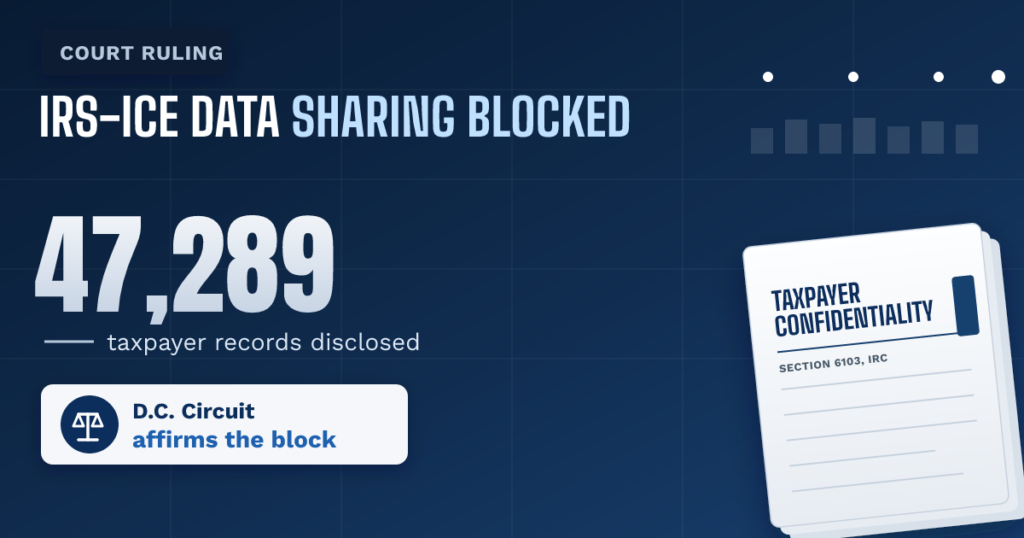
A federal appeals court has upheld an order blocking an Internal Revenue Service procedure that allowed taxpayer information to be shared with U.S. Immigration and Customs Enforcement.
In a September 8 opinion, the U.S. Court of Appeals for the District of Columbia Circuit said the IRS procedure failed to ensure that ICE requests satisfied the requirements of federal taxpayer-confidentiality law. The court affirmed the district court’s preliminary relief.
What the IRS disclosed
The court record says ICE sought the last known addresses of as many as 1.28 million people suspected of remaining in the United States after final removal orders.
The IRS created a data-exchange procedure for responding to those requests. By the time the district court intervened, the IRS had identified and disclosed 47,289 records to ICE.
More than 90 percent of those records were produced through a taxpayer-identification-number matching method. Under that method, the IRS could return an address from its records even when ICE had not provided a complete address for the taxpayer.
Why the court found the procedure deficient
Section 6103 of the Internal Revenue Code generally makes tax returns and return information confidential. It permits certain disclosures for specified non-tax criminal investigations only when statutory conditions are met.
Among other requirements, the requesting agency must provide the taxpayer’s name and address, identify the relevant taxable period and statutory authority, and explain why the information may be relevant to the investigation.
The IRS procedure checked only whether ICE entered five or nine digits in an address field. According to the court, those digits did not have to be a real ZIP code, and ICE did not have to provide a street, city or state. The procedure also did not ensure that information was released only to officers personally and directly involved in a qualifying investigation.
The appeals court concluded that the plaintiffs were likely to succeed in showing that the procedure violated federal law.
What the ruling does
The decision leaves in place the district court’s order staying the IRS data-exchange procedure and prohibiting further disclosures except in strict compliance with federal law. The government must also notify the district court before responding to future DHS requests for taxpayer information.
The ruling concerns the legality of the IRS procedure, not the validity of individual removal orders. It does not prevent ICE from using information obtained through other lawful sources.
What the ruling does not resolve
The case is at the preliminary-injunction stage. The appeals court held that the plaintiffs were likely to succeed and that preliminary relief was justified. It did not issue a final judgment resolving every claim in the underlying lawsuit.
The opinion also does not require the IRS to retrieve information already disclosed. The record establishes that 47,289 records had already been transmitted before the district court blocked further use of the procedure.
Why the case matters to immigrant taxpayers
Many people who do not qualify for Social Security numbers file tax returns using Individual Taxpayer Identification Numbers. Federal law does not make tax information generally available for civil immigration enforcement.
The D.C. Circuit emphasized that Congress imposed detailed restrictions on sharing tax information after past executive-branch abuses. Any broader authority for agencies to share this information would require congressional action rather than an administrative workaround.
The case is Center for Taxpayer Rights v. Internal Revenue Service, No. 26-5006, in the U.S. Court of Appeals for the District of Columbia Circuit.