
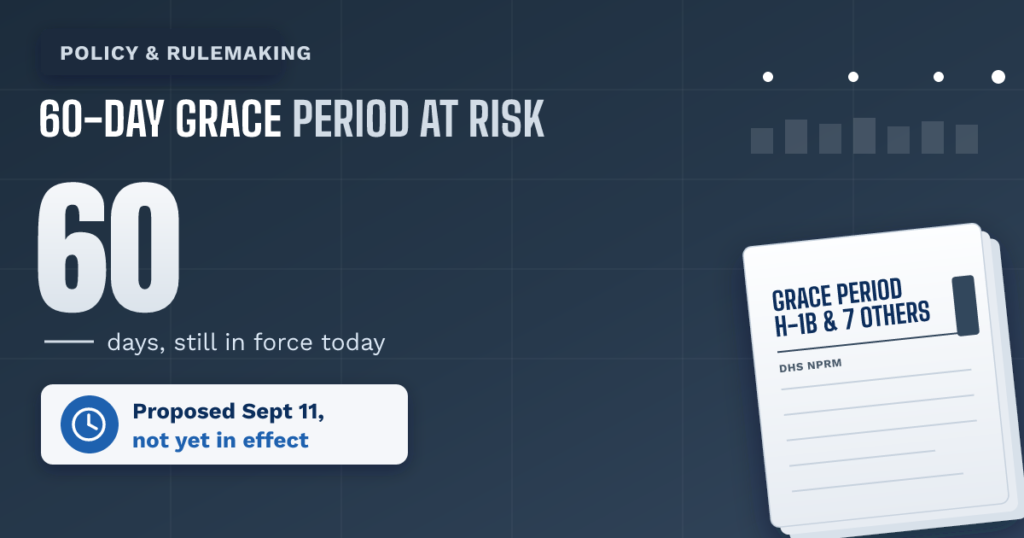
The Department of Homeland Security has released a proposed rule that would eliminate the discretionary grace period of up to 60 days after employment ends for workers in eight nonimmigrant classifications and their dependents.
The proposal is scheduled for publication in the Federal Register on September 11, 2026. It would affect E-1, E-2, E-3, H-1B, H-1B1, L-1, O-1 and TN nonimmigrants.
The proposal is not in effect. The current grace period at 8 CFR 214.1(l)(2) remains available. DHS would have to review public comments, issue a final rule and announce an effective date before the regulation could change.
What DHS is proposing
DHS proposes removing 8 CFR 214.1(l)(2), the regulation that permits eligible workers and their dependents to be treated as maintaining status for up to 60 consecutive days after the employment supporting their status ends, or until the end of their authorized validity period, whichever is shorter.
If the proposal becomes final in its current form, an affected worker would generally be considered to have failed to maintain status beginning the day after the qualifying employment or activity ends, unless the person has another basis to remain lawfully in the United States.
The proposal would apply to:
- E-1 treaty traders
- E-2 treaty investors
- E-3 Australian specialty occupation workers
- H-1B specialty occupation workers
- H-1B1 workers from Chile and Singapore
- L-1 intracompany transferees
- O-1 workers of extraordinary ability or achievement
- TN professionals from Canada and Mexico
Dependent spouses and children whose status is tied to the principal worker would also be affected. DHS says employment-authorized dependent spouses, including certain H-4 and L-2 spouses, could face an immediate loss of work authorization if the principal worker loses status.
What does not change today
The current rule still applies. Eligible workers may continue to rely on the discretionary grace period of up to 60 days, subject to the end date on their authorized stay and USCIS discretion.
The proposal does not itself cancel anyone’s current status, create an immediate departure deadline or change an already effective regulation. News headlines describing the grace period as already eliminated are premature.
The separate grace periods connected to the end of an authorized validity period are not the target of this proposal. The proposal specifically removes the post-employment grace period at 8 CFR 214.1(l)(2).
Why DHS says it wants the change
DHS says the grace period disconnects nonimmigrant status from the employment or activity on which that status is based and adds administrative work for USCIS officers deciding later petitions or applications.
The agency considered shortening the grace period or removing it only for some classifications. It rejected both alternatives, saying neither would fully address its stated statutory and administrative concerns.
What the proposal says about the impact
DHS acknowledges that workers may have less time to find a new employer, seek another lawful status or arrange departure. It also acknowledges possible lost compensation, relocation costs, disruption to families and temporary productivity losses for employers.
Because USCIS does not directly record every use of the grace period, DHS says it cannot reliably estimate the total number of affected workers. As a proxy, the agency identified approximately 5,178 workers in fiscal year 2025 for whom about 2,886 entities filed change-of-employer petitions during a possible grace-period window. DHS cautions that this method does not capture all uses of the current rule.
What happens next
The public will have 60 days after publication to submit comments under DHS Docket No. USCIS-2026-0364. The advance document is scheduled to be published on September 11, making the expected comment deadline November 10, 2026. The Federal Register page should be checked after publication for the final listed deadline.
The proposal previously cleared White House regulatory review on August 27. After the comment period closes, DHS must consider the comments before deciding whether to issue a final rule. The agency could revise the proposal, withdraw it or publish a final rule with a future effective date.
Workers facing an actual or expected job loss should not treat this proposal as individualized legal advice. Timing, I-94 validity, pending applications and possible changes of employer or status can materially affect a person’s options.