
The newest USCIS immigration data contains a striking development for one of America’s most closely watched employment-based green card categories.
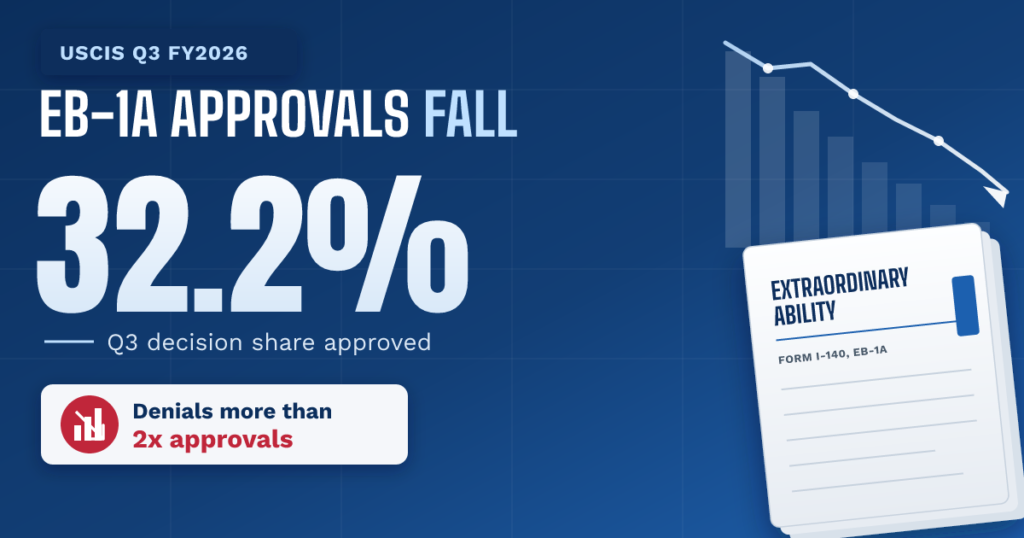
Only about 32.2 percent of EB-1A petitions decided during FY2026 Q3 were approved, based on calculations from USCIS Form I-140 data.
USCIS recorded approximately 1,348 EB-1A approvals during the quarter. Against approximately 2,832 denials, denials were more than twice the number of approvals among petitions decided during the reporting period.
USCIS also received 6,036 new EB-1A petitions during the three months from April through June.
The direction has been unmistakable
The Q3 result did not emerge in isolation. The share of decided EB-1A petitions approved was approximately 47 percent in FY2026 Q1, approximately 42 percent in Q2 and approximately 32 percent in Q3.
That does not prove USCIS formally changed the legal standard. It does show that the outcomes recorded in USCIS’s data became considerably less favorable across those quarters.
Meeting three criteria is not the whole test
USCIS extraordinary-ability guidance explains that an EB-1A petitioner can qualify to self-petition without a job offer or labor certification. The guidance also explains that satisfying at least three regulatory criteria is followed by an evaluation of the evidence in its totality to determine whether the required level of sustained national or international acclaim has been shown.
Nearly 29,000 cases remained pending
Approximately 28,874 EB-1A petitions remained pending at the end of the reporting period. Combined with more than 6,000 new receipts during Q3, the data shows continuing demand for the category even as quarterly decision outcomes became more challenging.
What applicants should not conclude
A 32 percent quarterly decision share does not mean a particular EB-1A applicant has a 32 percent chance of success. USCIS quarterly statistics aggregate petitions with different fields, accomplishments, evidence and factual records. They also compare approvals and denials issued during a quarter, not necessarily petitions received during that same quarter.
Still, the change is significant as an aggregate trend. USCIS’s Q3 data shows that fewer than one in three EB-1A approval-or-denial decisions during the quarter were approvals.