
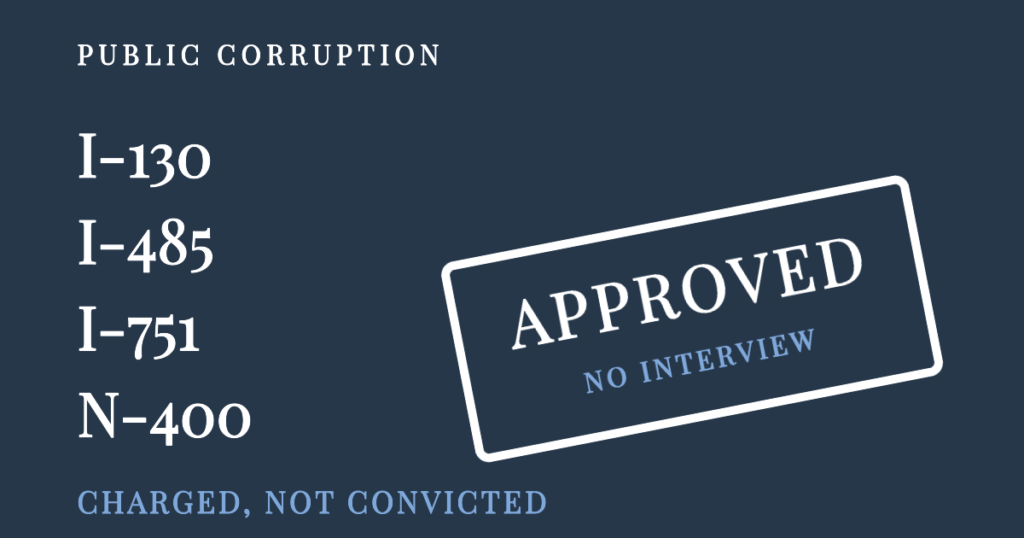
A federal criminal complaint filed on 31 August 2026 in the Northern District of Texas accuses a former Senior Immigration Services Officer at USCIS of approving green card and naturalization applications in exchange for money over a period of more than six years. Federal agents arrested Lukman Owolabi Ganiyu and a second man, Adeniyi Akeem Somoye, on 2 September. Both appeared before a United States Magistrate Judge the same day.
Both men are charged, not convicted. A criminal complaint is an allegation and nothing more. Every fact below is an allegation drawn from the complaint as described by the Department of Justice, and both defendants are presumed innocent unless the government proves its case beyond a reasonable doubt.
What the government alleges
According to the complaint, from December 2019 through March 2026 Ganiyu used his official position to approve immigration applications in exchange for payments. The forms named in the complaint cover most of the family-based and naturalization pipeline:
- Form I-130, Petition for Alien Relative
- Form I-485, Application to Register Permanent Residence or Adjust Status
- Form I-751, Petition to Remove Conditions on Residence
- Form N-400, Application for Naturalization
Investigators allege that Ganiyu bypassed required interviews, supervisory review, jurisdictional limitations, background checks and standard USCIS processing protocols in order to expedite approvals. Many of the applicants, prosecutors say, were not eligible for the benefits they received.
The complaint alleges that Ganiyu and Somoye together collected hundreds of thousands of dollars from applicants, and that several of those payments line up directly with approvals Ganiyu issued. Investigators also say they recovered extensive WhatsApp traffic between the two men and applicants whose cases they were handling, running to thousands of messages and hundreds of calls across the charged period.
Some outlets have reported a figure of roughly 960,000 dollars. That number does not appear in the Department of Justice announcement, which says only hundreds of thousands of dollars. Treat the larger figure as unconfirmed.
The jurisdiction problem
The detail that makes this case unusual is not the money. It is the jurisdictional bypass.
USCIS field offices are geographically bounded. An officer in Dallas handles Dallas cases. The complaint alleges that Ganiyu joined USCIS in November 2018, worked in Kansas, Texas and North Carolina, and was promoted to senior immigration services officer in Dallas in April 2024. According to the affidavit, he assigned himself to Somoye’s own naturalization application and approved it the same day, in December 2022.
An officer who can reach outside his own field office, skip the interview, skip supervisory review and skip the background check has effectively removed every checkpoint the adjudication system relies on. That is a different failure from a single bribe taken at a single interview.
What the officials said
United States Attorney Ryan Raybould said that selling immigration benefits for cash is a blatant abuse of public trust, and that when a federal official puts a price tag on lawful status, his office will intervene immediately.
FBI Dallas Special Agent in Charge R. Joseph Rothrock said the alleged manipulation of immigration decisions for personal gain undermines the integrity of a process essential to national security.
The charge and the penalty
Both men are charged with conspiracy to receive illegal gratuities by a public official. Each faces up to five years in federal prison and a fine of up to 250,000 dollars.
The illegal gratuities charge is a lighter charge than bribery. Bribery requires the government to prove a corrupt agreement, a quid pro quo. An illegal gratuities count requires only that something of value was given or received because of an official act. Prosecutors sometimes charge gratuities first and supersede with a bribery indictment later. Whether that happens here is not yet known.
The case was investigated by the USCIS Office of Investigations, the DHS Office of Inspector General and the FBI Dallas Field Office. Assistant United States Attorney Chad Meacham of the fraud section is prosecuting.
Why this matters beyond Dallas
The charged period runs to March 2026. In late April 2026, USCIS implemented enhanced fingerprint-based background checks that required re-vetting and produced temporary holds on pending green card and naturalization applications nationwide. Those two facts sit close together on the calendar. Whether they are connected has not been stated by the agency, and we are not asserting that they are.
What can be said is that a corruption case at this scale gives the agency a public reason to tighten adjudication controls, and applicants who had nothing to do with any of it tend to absorb the delay.
This is also not an isolated matter. In Philadelphia, former USCIS officer Amara Dukuly pleaded guilty in March 2026 to aiding and abetting the bribery of a public official.
What we do not know
The Department of Justice announcement does not name any applicant, does not say how many approvals are affected, and does not say whether USCIS intends to review or reopen cases Ganiyu adjudicated. The agency has not announced any such review.
People whose cases were adjudicated in the Dallas field office during the charged period have no announced action to take and no announced exposure. Anyone with a specific concern about their own case should speak with a licensed immigration attorney. TR Immigration is an independent information platform. We do not provide legal advice or assess anyone’s eligibility.
Sources