
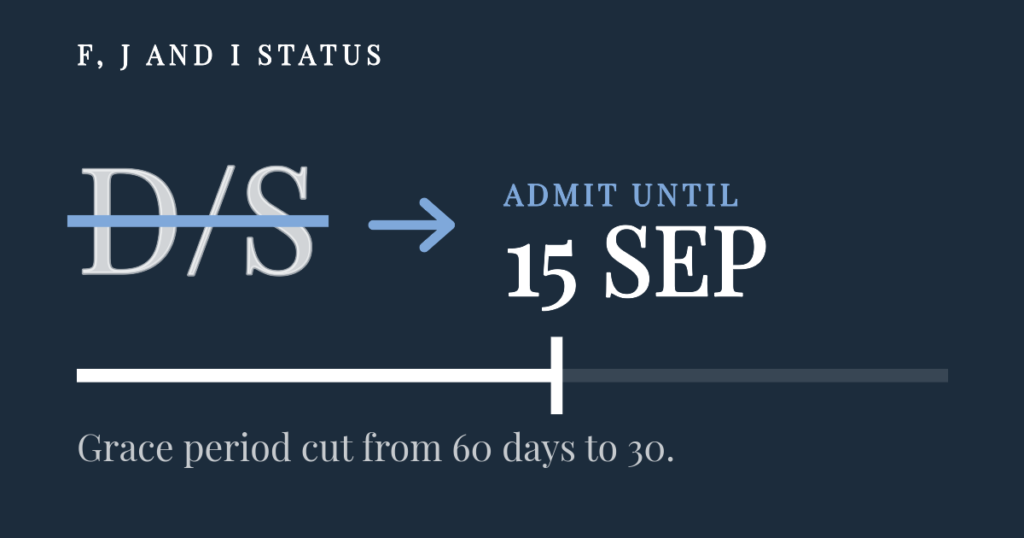
The Department of Homeland Security rule that ends duration of status for F academic students, J exchange visitors and I representatives of foreign information media takes effect on 15 September 2026. It was published in the Federal Register on 17 July 2026 under the title Establishing a Fixed Time Period of Admission and an Extension of Stay Procedure for Nonimmigrant Academic Students, Exchange Visitors, and Representatives of Foreign Information Media.
A federal court in Massachusetts heard argument on a motion to block the rule on 3 September 2026. As of publication no order suspending the rule has been issued. Until a court issues a stay, an injunction or a vacatur, 15 September remains the operative date.
What duration of status was
Under the framework in place since the 1970s, most F-1 students and J-1 exchange visitors were admitted for duration of status. The Form I-94 carried the notation D/S rather than a calendar date. Status continued for as long as the person complied with the terms of the program, and no filing with USCIS was needed simply to keep the admission period alive.
What replaces it on 15 September
Each of the three classifications receives a fixed admission end date, called the admit until date, on the Form I-94.
F students. Admission runs for the length of the program of study listed on the Form I-20, not to exceed four years, plus a 30-day period for arrival and an additional 30-day period for departure. The 30-day arrival and departure periods do not count against the four-year maximum. Where the person holds an OPT or STEM OPT employment authorization document, admission may instead run to the end date of that authorization if that date is earlier.
J exchange visitors. Admission runs for the length of the exchange program shown on the Form DS-2019, not to exceed four years, plus a 30-day departure period.
I nonimmigrants. Those present in the United States on the effective date who were admitted for duration of status are authorized to remain for the period necessary to complete their activities, not to exceed 240 days from that date. For holders of passports issued by the People’s Republic of China, other than Hong Kong SAR and Macau SAR passports, the period is 90 days.
Anyone who needs more time than the admit until date allows must either file an extension of stay with USCIS on Form I-539 or depart the United States and seek a new period of admission from Customs and Border Protection on return.
The grace period is shorter
Under the existing regulation, F-1 students have 60 days after completing a program of study or a period of practical training to prepare for departure. The final rule reduces that to 30 days, which aligns the F-1 period with the 30 days that J-1 exchange visitors already receive.
The transition provision, and the date attached to it
This is the part that matters most for students graduating in the coming academic year.
An F-1 student whose Form I-94 shows D/S, who is present in the United States on 15 September 2026, and who timely files Form I-765 for post-completion OPT or for a STEM OPT extension on or before 18 March 2027, does not have to file a separate extension of stay on Form I-539 for that OPT or STEM OPT period. The 18 March 2027 date is 244 days from publication of the rule.
Two points on how that date works. First, the relevant moment is the date USCIS receives the Form I-765, not the date the student graduates. Second, students who file for post-completion OPT or STEM OPT by 18 March 2027 but who travel before the practical training is approved may be readmitted by Customs and Border Protection with a fixed period of admission.
An F student who departs and is readmitted with a fixed period of admission before filing for post-completion OPT or STEM OPT must file an extension of stay application along with the OPT or STEM OPT application.
On or after 18 March 2027, the exemption is gone. Filings for post-completion OPT and STEM OPT will require both Form I-765 and Form I-539.
Forms change on the same day
USCIS has said it will publish revised editions of Form I-539, Application to Extend/Change Nonimmigrant Status, and Form I-765, Application for Employment Authorization, on 15 September 2026. Both carry the edition date 09/15/26. The agency has stated that the revisions align the forms with this final rule.
Where the litigation stands
On 18 August 2026 a coalition led by NAFSA: Association of International Educators and the Presidents’ Alliance on Higher Education and Immigration, joined by the Association of Independent Colleges and Universities in Massachusetts, the American Federation of Teachers, Graduate Labor Organization AFT Local 6516, the International Union, UAW, UAW Local 2322 and the NewsGuild-CWA, filed a complaint and a motion for preliminary injunction in the United States District Court for the District of Massachusetts.
The complaint argues that the rule violates the Administrative Procedure Act, alleging that DHS failed to adequately assess costs and benefits, failed to meaningfully respond to public comments, failed to consider less burdensome alternatives, failed to justify the rule against its own stated objectives, provided an inadequate comment period, and exceeded its statutory authority. The case is assigned to District Judge F. Dennis Saylor IV. The government filed its response on 2 September 2026 and the motion hearing was held on 3 September 2026.
Separately, the rule is classified as a major rule subject to congressional review. DHS has said it will publish an additional Federal Register document if the congressional review process changes the effective date or terminates the rule.
Filing a lawsuit does not suspend a final rule. The practical position for anyone affected is to prepare on the assumption that the rule takes effect on schedule, while watching the docket.
What this changes in practice
Three shifts are worth naming plainly. Admission periods now expire on a date rather than on a condition, so the I-94 becomes a document to check and diarize rather than one to file away. Program changes and program extensions that previously required only a new Form I-20 may now require a filing with USCIS. And because an authorized stay will end on a fixed date, a pending Form I-765 will not by itself hold that stay open once the transition provision no longer applies.
Anyone in F, J or I status should confirm their current admit until date, confirm their program end date on the Form I-20 or DS-2019, and speak with the designated school official or responsible officer at their institution before making travel plans that cross 15 September 2026.
Official sources
Final rule, Federal Register, 17 July 2026. DHS Study in the States guidance on the final rule. USCIS newsroom alerts on the 09/15/26 editions of Forms I-539 and I-765. NAFSA case page and the Presidents’ Alliance litigation page for the docket.