
Update, September 10, 2026: DHS has now released the proposal for publication on September 11. The rule is still not in effect. Read the full update and official proposal.
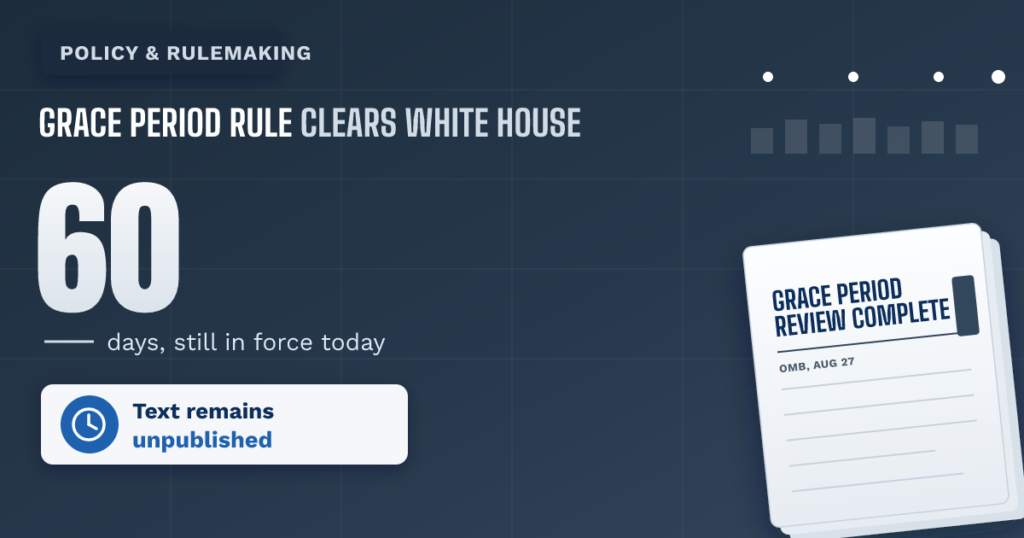
A Department of Homeland Security proposal that would eliminate the discretionary 60-day grace period for certain nonimmigrant workers has completed review at the White House Office of Information and Regulatory Affairs. The regulatory record lists the review as concluded on 27 August 2026, with the outcome recorded as consistent with change.
The proposal is titled Eliminating the Discretionary 60-day Grace Period and carries regulatory identification number 1615-AD22. The OIRA record lists DHS and USCIS as the agency, records the proposal as received on 6 August 2026 and concluded on 27 August 2026, and gives the stage as proposed rule. The publication date field is blank.
Start with the most important fact: nothing has changed today. The grace period at 8 CFR 214.1(l) remains in force. A worker laid off this week is governed by the current rule, not by this proposal.
What the current rule provides
Since the regulation took effect in January 2017, workers in E-1, E-2, E-3, H-1B, H-1B1, L-1, O-1 and TN status, along with their dependents, may be treated as maintaining status for up to 60 consecutive days after the employment supporting that status ends, or until their authorized period of stay expires, whichever is shorter.
The period is discretionary, which means DHS can shorten it or decline to grant it. It is available once during each authorized validity period. It does not authorize employment. What it does allow is time for a new employer to file a petition, for the worker to apply for a change of status, or to arrange departure.
What clearing review does and does not mean
Review at the Office of Information and Regulatory Affairs is an internal step that happens before a proposed rule is published. Clearing it means DHS may now publish the proposal in the Federal Register as a notice of proposed rulemaking. It does not change any regulation.
The text is not public. The scope, any exceptions, any transition provisions and any proposed effective date are all unknown. Reporting that describes the grace period as already eliminated is describing something that has not happened.
What happens next
On publication, a public comment period opens, typically 30 or 60 days. DHS must then consider the comments before it can issue a final rule, and a final rule would carry its own effective date. For comparable immigration regulations, that sequence has historically taken several months or longer from the close of comments.
The regulatory record lists no publication date. The next thing to watch is the Federal Register.
Two entries on the record are worth noting. DHS has marked the proposal as neither major nor economically significant, and has recorded no legal deadline. It has also marked a regulatory flexibility analysis as required, with small entities affected identified as businesses and organizations, which means the agency expects to have to assess the burden on smaller employers when it publishes.
Why it matters
Before the 2017 regulation there was no grace period. Termination generally meant an immediate end to status. If this proposal is finalized as its title suggests, that is the position it would restore, and the loss of a job would mean the loss of status for the worker and for any dependents whose status derives from theirs.
Official sources
Office of Information and Regulatory Affairs, conclusion of Executive Order 12866 regulatory review, RIN 1615-AD22. Current regulation at 8 CFR 214.1(l).