
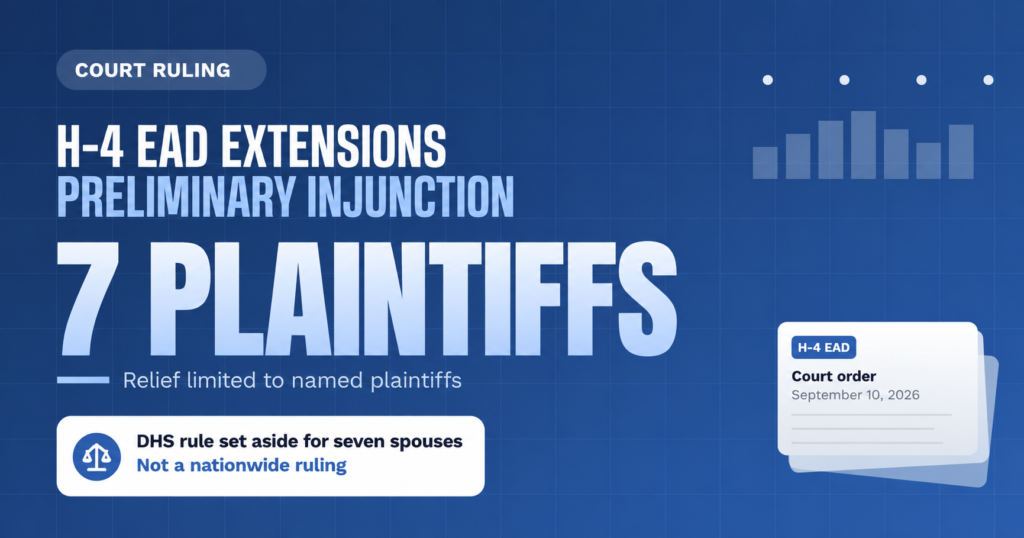
A federal judge in California has granted a preliminary injunction to seven H-4 spouses challenging the Department of Homeland Security’s decision to end automatic extensions of employment authorization documents. The relief is significant for the seven plaintiffs, but the court expressly declined to issue a nationwide injunction.
What the court ordered
U.S. District Judge David O. Carter of the Central District of California ordered that DHS’s October 30, 2025 interim final rule ending automatic EAD extensions be immediately set aside as to the seven named plaintiffs. The court said the government may implement the relief by providing EADs effective throughout the pendency of the case.
The order also certified the matter for an interlocutory appeal. Judge Carter explained that the case raises largely legal questions about how the government implemented the regulation and said an appellate court should have an opportunity to address those issues without a nationwide injunction first.
Why the judge found the rule vulnerable
The dispute centers on DHS’s October 2025 interim final rule, which ended the prior automatic-extension framework for certain EAD renewal applicants. DHS made the rule effective without the ordinary notice-and-comment process, invoking exceptions under the Administrative Procedure Act.
The court concluded that the seven plaintiffs were likely to succeed on their APA challenge. It rejected DHS’s reliance on the good-cause emergency exception, including the government’s argument that advance notice could cause applicants to rush to file renewals before the change took effect.
The court also found that the security example DHS cited did not adequately establish an urgent connection between automatic work authorization extensions and the asserted public-safety threat. In addition, the judge said DHS had not sufficiently explained why existing continuous-vetting systems, including ATLAS and Continuous Immigration Vetting, were inadequate alternatives.
The court also rejected the foreign-affairs justification
DHS argued that the foreign-affairs exception to notice-and-comment requirements applied because employment authorization can affect immigration status and cross-border flows of money. The court disagreed, emphasizing that the case concerns employment eligibility within the United States and finding that the asserted connection to foreign affairs was too attenuated.
Employment gaps counted as irreparable harm
The court found that the plaintiffs faced irreparable harm from extended lapses in their ability to work. The order noted that the consequences could go beyond lost wages, affecting career progression, future earning potential and employability. It also concluded that the balance of hardships and the public interest favored the plaintiffs, including the public interest in compliance with the APA.
What this means for other H-4 EAD holders
This decision does not restore automatic EAD extensions nationwide. The preliminary injunction applies only to the seven named plaintiffs. Other H-4 EAD holders should not assume that the October 30, 2025 rule has been suspended for them based on this order alone.
The distinction is especially important because the court specifically chose not to grant nationwide relief. The order states that the plaintiffs could renew a request for broader relief if the government ultimately decides not to appeal.
What happens next
The court certified the ruling for appeal, making appellate review a likely next stage. The underlying lawsuit also continues, and the preliminary injunction is not a final judgment on the merits.
TR Immigration will continue tracking the case and any appeal or later order that could change the scope of relief.
Case details
Case: Jane Doe 1 et al. v. United States Department of Homeland Security
Court: U.S. District Court for the Central District of California, Southern Division
Case No.: 8:26-cv-00060-DOC-KES
Order: Preliminary injunction, Document 46
Signed: September 10, 2026
Filed: September 11, 2026
This article reports on a federal court order and is for general informational purposes. It does not provide legal advice or determine how the ruling applies to any individual case.