
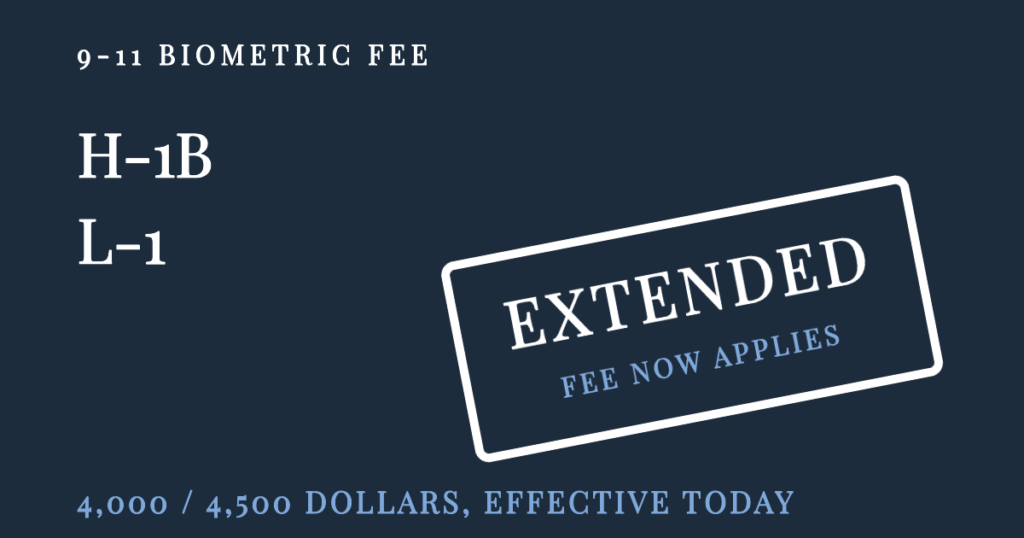
A final rule from the Department of Homeland Security took effect today, 9 September 2026. Covered employers must now pay the 9-11 Response and Biometric Entry-Exit Fee on every H-1B and L-1 extension of status petition, including a routine extension filed by the same employer that already sponsors the worker. The rule was published in the Federal Register on 10 August 2026 at 91 FR 51360.
The fee amounts have not changed. What changed is which petitions trigger them.
What was exempt before today
Congress created the fee in Public Law 114-113 in 2015 to help fund the biometric entry-exit system operated by Customs and Border Protection. DHS had generally required it only on an initial H-1B or L-1 petition or on a petition that changed the worker’s employer. A same-employer extension, filed after that initial petition, was generally treated as outside the fee, so an employer could sponsor a worker through repeated extensions without paying it again.
DHS now says that reading did not give full effect to the statute. The corrected rule requires the fee on all extension of status petitions filed by a covered employer, regardless of whether the separate fraud prevention and detection fee also applies.
Who is covered
The fee reaches only employers with 50 or more employees in the United States, more than half of whom hold H-1B or L-1 status, counted in the aggregate. This is the same test that has applied since 2015; the rule does not expand which employers are subject to the fee, only which of their filings trigger it. Employers below that threshold are not affected.
What it costs
A covered employer filing an H-1B extension on or after today owes an additional 4,000 dollars at filing. A covered employer filing an L-1 extension owes an additional 4,500 dollars. An amended petition that does not also request an extension of status remains exempt; the fee attaches to the extension request itself.
Not retroactive
The rule applies only to petitions filed on or after 9 September 2026. A petition that reached USCIS before today is governed by the prior rule even if USCIS adjudicates it later. Several immigration law firms have advised covered employers to review pending extension filings and to expect no grace period and no waiver process built into the rule itself.
Why this matters going forward
For a covered employer, what was close to a one-time cost per worker now recurs at every extension. The statutory authorization for the underlying fee is currently scheduled to expire after 30 September 2027 unless Congress renews it, which would also end the expanded requirement created by this rule.